When considering distinct features of current circulating coins, one feature stands out – holes in the centre of coins. There is a long history of coins deliberately minted with holes in the centre, but most nations have abandoned the practice either as they developed modern currencies or (not unrelated to the previous reason) as anti-counterfeiting technologies advanced.
There are, however, a small number of these coin still in circulation – with Japan, Denmark, Norway, and Papua New Guinea counted among the countries continuing the practice.
So, why produce coins with holes in the first place?
One of the earliest examples of holed coinage are China’s cash (or qián) coins, which featured square holes in their centres and were in use throughout the Imperial China period. Further examples of previous currencies with holes in the centre include the Japanese mon, Korean mun, Ryukyuan mon, and Vietnamese văn.
These coins could be threaded onto strings or cords, making them easier to count, transport and store in large quantities. Nowadays, such coins are considered to be symbols of good fortune.
A variety of further examples of holed coins includes those with holes punched or drilled through. Although they were not deliberately struck with holes in them, people drilled holes into the coins to carry them around, either by stringing them together or sewing them into the lining of clothes. Others were nailed to buildings for good luck, or worn as jewellery.
Further reasoning for holed coins includes reduced financial costs, with the removal (and then potential reuse elsewhere) of metal from the centre of a coin reducing material costs. The use of casting to create some older coins also resulted in a batch of coins cooling into a shape somewhat reminiscent of a tree with ‘branches’. Breaking the coins off the branches left material that needed to be filed, and the inclusion of a square hole in the centre of the coins enabled them to be lined up and filed together.
Holed coins also offer an inbuilt anticounterfeiting feature, as a counterfeiter producing a holed coin must accurately reproduce not only the coin’s diameter, weight and composition, but also the exact size and positioning of the hole. However, modern mints now rely far more heavily on advanced security technologies, including specialised metal alloys, bimetallic construction, and micro-lettering, for example.
Ultimately, the continued circulation of holed coins is driven less by security concerns and more by tradition and identification, with their distinctive shape making them instantly recognisable by touch and helping people identify denominations without looking at them. This feature is particularly beneficial for people with visual impairments.
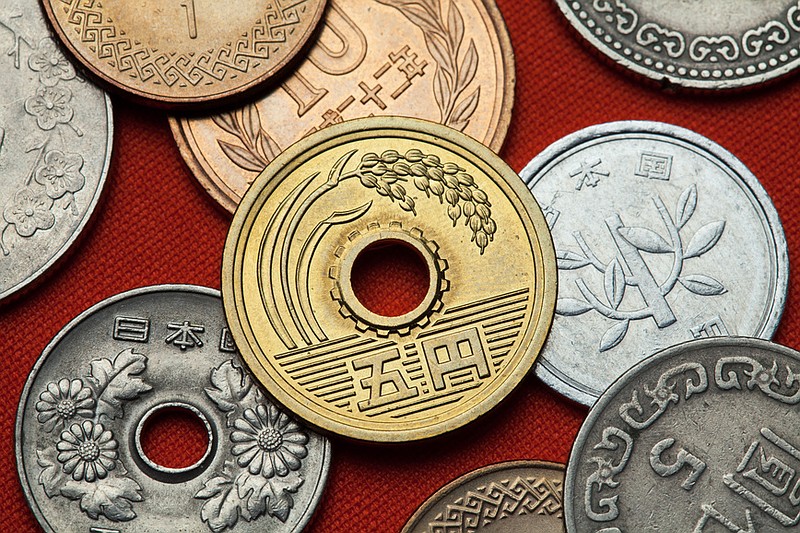
Japan’s currency includes two holed coins, with the 5 yen reflective of the region’s long history of perforated coinage; the 50 yen followed suit in 1959 and was pierced to help distinguish it from the similarly sized and coloured 100 yen coin.
Denmark continues to circulate three holed denominations – the 1, 2, and 5 kroner coins – with the holes introduced for the first time in 1924 in order to help distinguish between the coins. This feature later disappeared from circulating coinage, but was reintroduced for the 25 øre coin in 1966. It remains on the three current middle denominations, including the latest versions that were released last year when five of the six circulating denominations were updated to mark the accession of King Frederik X to the throne.
Similarly, Norway retains central holes on its circulating 1 krone and 5 kroner coins to assist in tactile identification. The modern version of these coins appeared in the 1920s to separate those featuring silver from those without, with the current versions introduced in the 1990s to differentiate between denominations and illustrate the updated coin designs.
Papua New Guinea’s 1 kina coin has featured a hole in the centre since the launch of the kina currency in 1975. The inclusion of the hole retains continuity between Papua New Guinea’s traditional and modern currencies, with the name ‘kina’ (and its subdivision ‘toea’) reflective of shells traditionally used as a means of payment and store of wealth.
DataVault Unlocked is a new periodic series from Coin & Mint News™, with the information drawn from DataVault, the new industry search engine that can filter and sort coin specifications by multiple fields in a matter of minutes, if not seconds.
As the writer of key industry newsletters, particularly Currency News™, Cash & Payment News™ and Coin & Mint News™ , the organiser of industry events and the publisher of technical publications for the cash industry, Reconnaissance International (RI) both gathers and uses data for the cash industry. As such, it has long recognised the importance of data for decision making in the cash industry. It also knows how hard it is to access and then organise that data.
In this context, RI created DataVault, a research database of every coin and banknote issued in the world. ‘Research’ because unlike websites that list coins and banknotes, DataVault is designed for users to be able to search quickly and easily for technical, design and security feature information. A member of the RI team with industry experience and knowledge maintains that data and the scope and depth of information is constantly evolving.
RI has now gone further, creating a brand new database of circulation data for coins and banknotes by denomination, volumes and values and with supporting demand and supply driver information.
Given that accessing cash in circulation data can be laborious work, Reconnaissance has added data for 64 countries to its DataVault software – with a specific Cash in Circulation module. While not every country provides coin data, all 64 have banknote data. DataVault Cash is still under development, with RI aiming to increase the data included ahead of its official launch. Those interested in viewing the module can explore data for six countries to get a sense of what is included and how the data can be compared.
Why not try DataVault 2.0 – including the Coin and brand new Cash modules – for yourself? Visit the link below to discover more about the database and what it offers.