
How Do Dog Bones Relate to Plated Coins?

A little history
In the past, solid coins comprised of a simple solid metal or alloy were the most popular coin structure. The next step was the clad structure, three or more metallic layers clad together, which was first used as an anti-counterfeit measure for precious metal coins and later became one of the structures to improve the security of circulated coins. Another step on the road to improve security was the introduction of a bi-colour type structure consisting of one or two rings and a coin core.
One of the latest trends is plating. However, security and the low-cost substrate by itself were not the main reasons behind the switch to plating, but rather it was influenced by the overall reduction of the cost of coin fabrication and improvement to seigniorage. As reported in the Coin Design Handbook¹, the security of the plated coins, particularly with a cheap magnetic steel base (core), was lower than the security of other designs.
Initially, the plated structures were used for low denomination coins. The rapid increase in the cost of raw materials changed the ‘seigniorage equation’ and now a larger number of mid and high denomination coins are also made using plating technology. Well-designed higher denomination plated coins are now produced using more secure non-magnetic base materials.
Is it genuine?
Detection of coins is critical from a security point of view. The principle is simple, and it should guide every decision: ‘even the best designed coin and best security feature has limited value if it can’t be reliably detected’. The most practical way to apply it is to ask the right questions before we turn the press on.
- Are all plated structures different enough to give us unique denomination and authentication decision?
- How does the choice of substrate and plated materials affect the security of the coin and its Electromagnetic Signature (EMS)²?
- Is the thickness variation of each of the layers of the plated structure small enough to secure unambiguous coin authentication?
- What about wear, quality of plated layers and its effect on coin fitness and corrosion?
- The EMS detection system usually checks multiple points along the coin chord (line across the coin) or diameter to make the decision. Is the structure the same for all the detection points?
- Why are my blanks ‘made to spec’ but minted coins are still rejected by the coin acceptors?
‘Dog bone’ and the case of plated coins
Coin blanks are plated in a barrel plating process. The non-conductive, perforated barrel is filled with thousands of coin blanks. It is subsequently submerged into a series of chemical tanks for cleaning, etching, rinsing, and electroplating. Parts of the process could be repeated to deposit varied materials and to create a multilayered structure.
The outcome of the barrel plating process is not perfect and the thickness of each plated layer of each of the blanks (and ultimately coins) will vary from blank to blank and from one side to the other. There is also a ‘dog ear’ or ‘dog bone’ effect. The metal coating builds up much thicker at the ends, edges, or corners of a blank compared to its middle.
The EMS of the coin is a function of the materials and the structure. The variation in the thickness of each of the plated layers between coins at various locations along the coin could have a significant effect on EMS and the authentication process.
Machine EMS conundrum
The EMS and machine detection of coins with copper, nickel, brass and bronze plating on magnetic and non-magnetic base materials (core) was presented at the Mint Directors Conference³. Here we focus on the horizontal 1D EMS characteristic of non-magnetic blanks plated with copper and nickel. The data collected at 960kHz offers a good ‘illustration’ of the effect.
Detecting the EMS of a coin is still a primary way to authenticate coins. Typically, the coin passes under the sensor along its chord or diameter. Detection systems collect data from one or two places along the scan line while more sophisticated systems can collect data from multiple points.
EMS detectors can excite coins with a single frequency, multiple frequencies, or one can use pulse excitation. The horizontal EMS characteristic of the solid base is shown in Figure 1. The characteristic is essentially constant (flat) except for the areas of the coin edges, where only the increasing or diminishing segments of the coin are under the sensor.
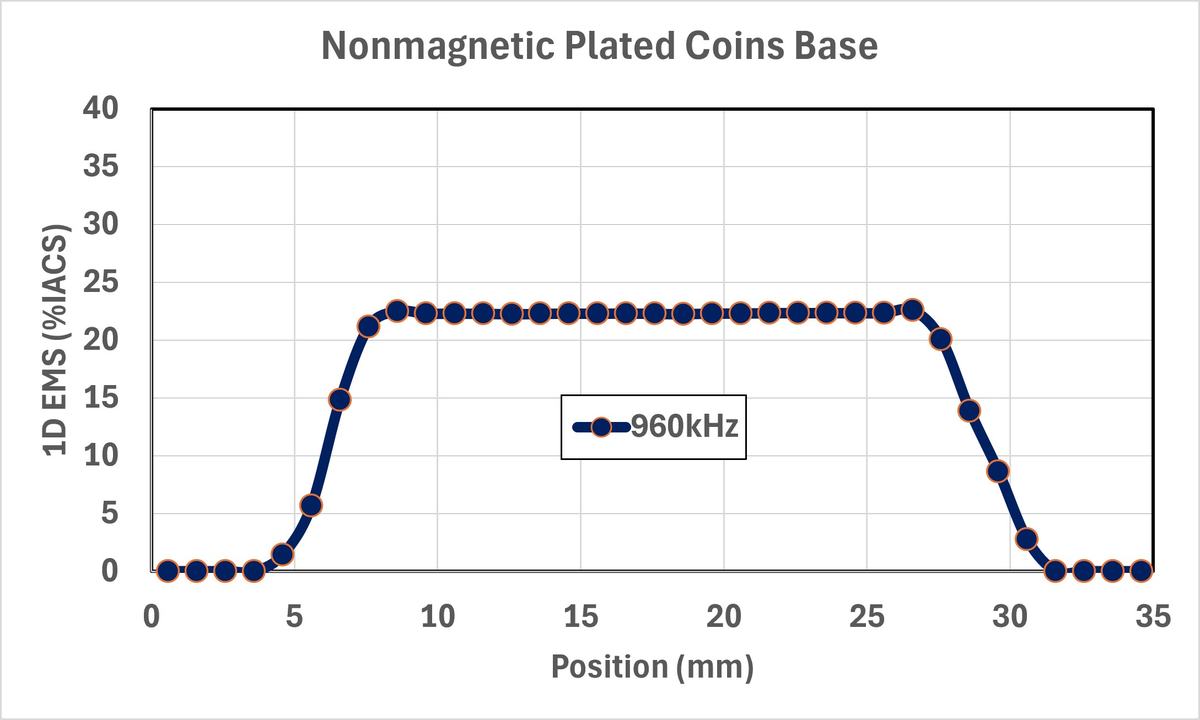
Since the 1D EMS of copper is bigger than the EMS of the non-magnetic base material, the EMS of the token with the plated structure (as shown in Figure 2) will be larger than the EMS of the base. Unlike the characteristic of the base, the EMS of the copper-plated coin is no longer ‘flat’ but is now convex. (Note the different vertical scales in Figures 1, 2, and 3). The EMS values at the edges of the token are significantly higher than the EMS measured in the centre.
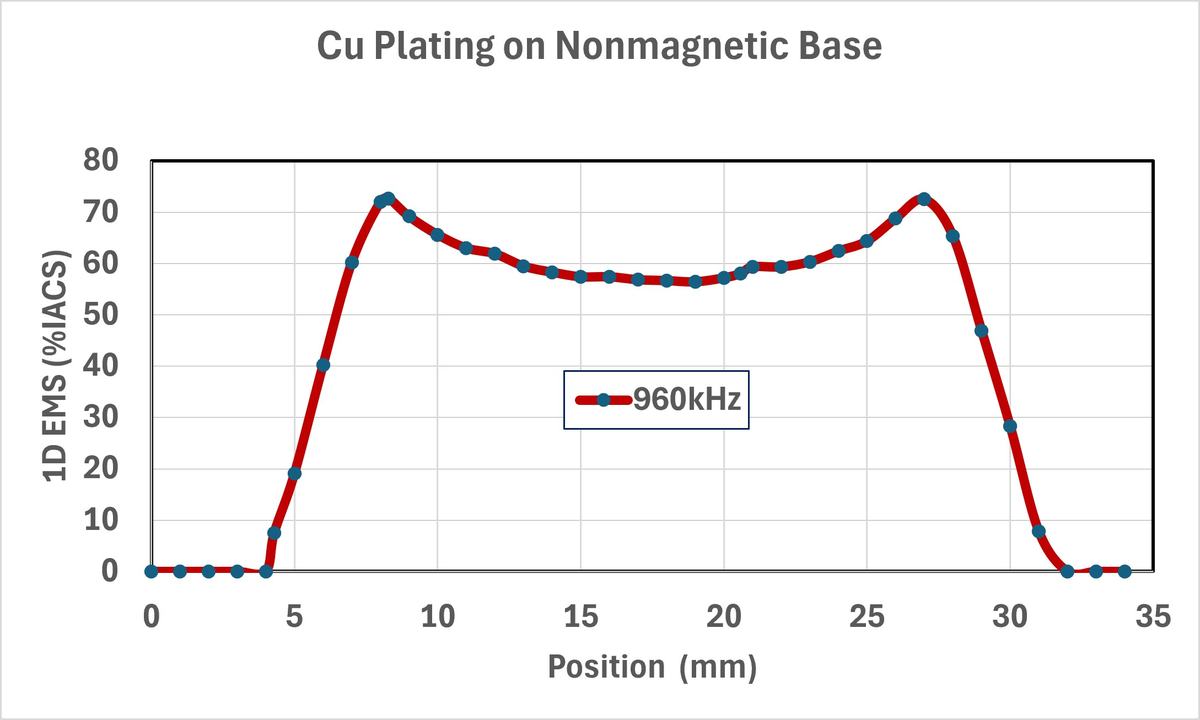
The curved effect on the graph is more pronounced for thicker copper layers and at higher test frequencies. At lower frequencies, the EMS of the base dominates the overall EMS of the structure. The contribution of plated materials has a higher effect on the token’s overall EMS at higher test frequencies.
Figure 3 illustrates the effect of nickel plating on top of a copper layer, on the same type of non-magnetic base. Copper is usually an underlayer for nickel plating. The shape of the 960kHz 1D EMS horizontal characteristic presented in Figure 2 has shifted from convex into concave. The shape of both characteristics is caused by the ‘dog bone’ plating effect.
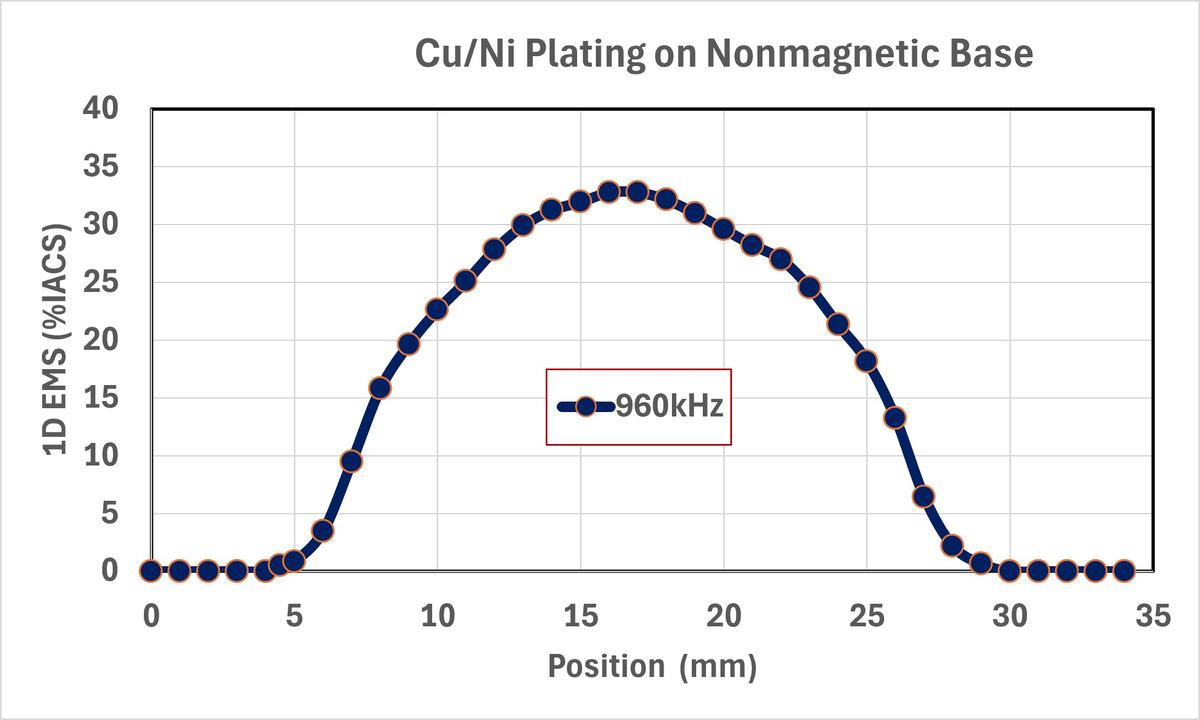
In the first case, the thicker layer of the high EMS copper is causing an increase to the EMS around the edges of the coin. In the second case, a thicker plated layer of the magnetic and low EMS nickel significantly reduces the 1D EMS around the coin edges.
The exact shape of the horizontal EMS characteristic depends on multiple factors such as coin structure, materials, or test frequency.
This illustrates the challenge that may be experienced with coin processing equipment. The horizontal EMS characteristic, which is critical for coin authentication, changes not only from coin to coin but also depends on which chord is used during the coin evaluation.
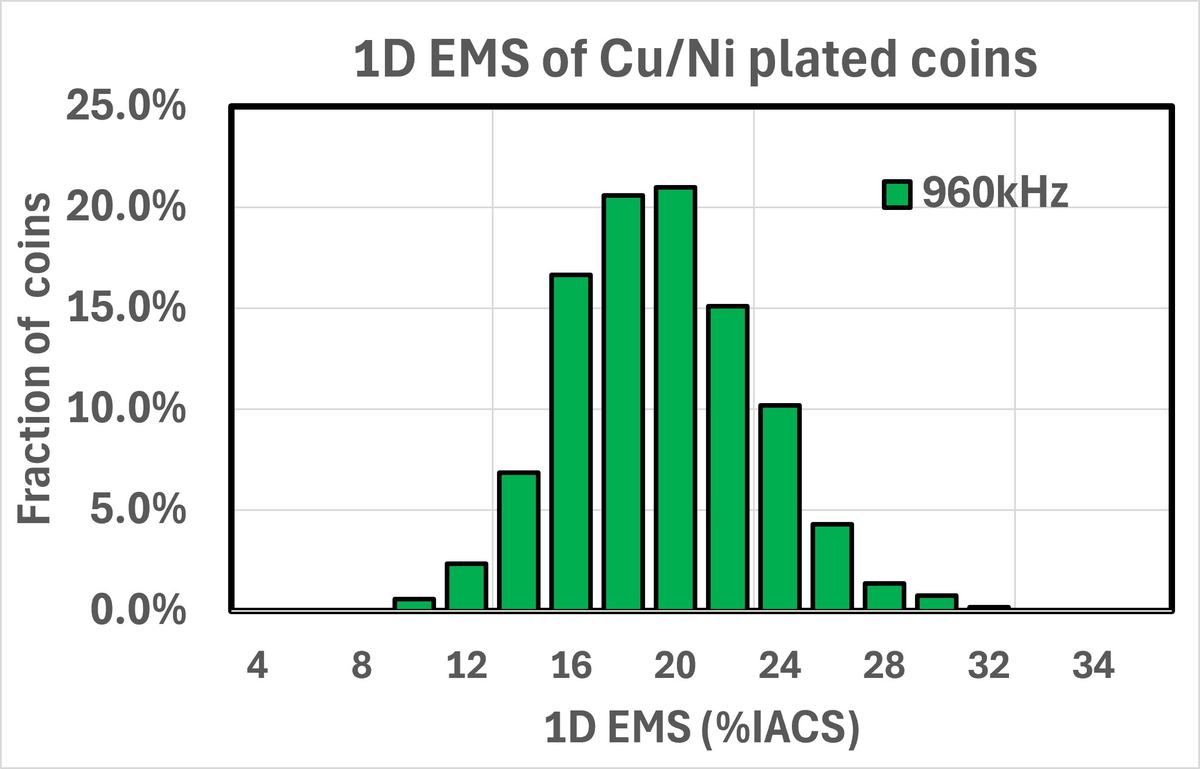
Figure 4 illustrates a distribution of EMS values across a group of single denomination coins plated with copper/nickel bilayers. The ‘dog bone’ makes the proper authentication of coins even harder. It also illustrates that specifying and testing EMS in the centre of the blank could lead to issues with coin authentication, particularly for sensors collecting multiple data along the coin chord and at different frequencies. The security of coins depends on the distribution of parameters used to authenticate coins. A broader distribution of EMS could make machine authentication more difficult and counterfeiter’s jobs much easier.
The next step
The ‘dog bone’ effect is common for electroplating. The shape of the horizontal 1D EMS depends on factors like coin structure, plated materials, base material, and machine test frequencies. I will leave you with a question: what do you do if the EMS of the plated blanks is meeting the spec (if you have one) but coins are not accepted by some of the machines?
If you would like to learn more about the ‘dog bone’ effect in plated coins and its impact on machine authentication, please contact us at [email protected] or visit NXTGenDetect.com.
1 - The EVA ‘Coin Design Handbook’, Version 3.1 (2017).
2 - T. Jagielinski, ‘The Importance of Coin EMS, How Coin Design Affects Machine Authentication’ Coin & Mint News (August, September, October 2025).
3 - M. Philips, ‘EVA-Sensor Sensitivity Study for Plated Coins’. Mint Directors Conference, Cape Town (2025).
Dr Tomasz Jagielinski is President and CTO of NXTGenDetect, an independent advisory firm focused on machine-readable security features and the machine detection and authentication of banknotes and coins. He holds 43 US patents and has published more than 100 technical papers and book chapters.
Get the Coin & Mint News™ Weekly delivered free to your inbox.