
The Precious Metals Market and its Unpredictability
To understand why gold, silver and platinum prices rose so sharply in early 2026 – by around 65% for gold, 140% for silver and more than 120% for platinum since July 2025 – we need to consider the roles these metals play and the demand factors that support them as non-income-bearing physical assets.
All three metals are widely held as stores of value by institutions, ETFs, and individual investors, while gold is also held by central banks. This reflects their relative scarcity, perceived beauty, and physical durability.
All three metals have multiple industrial uses (see below). For silver and platinum in particular, supply-and-demand dynamics support prices, although volatility is driven more by:
- Government policies and interest rate decisions
- Currency fluctuations
- Inflationary pressures
- Geopolitical and economic uncertainties.
These factors lead to large scale central bank buying, in addition to demand from institutions and individuals.
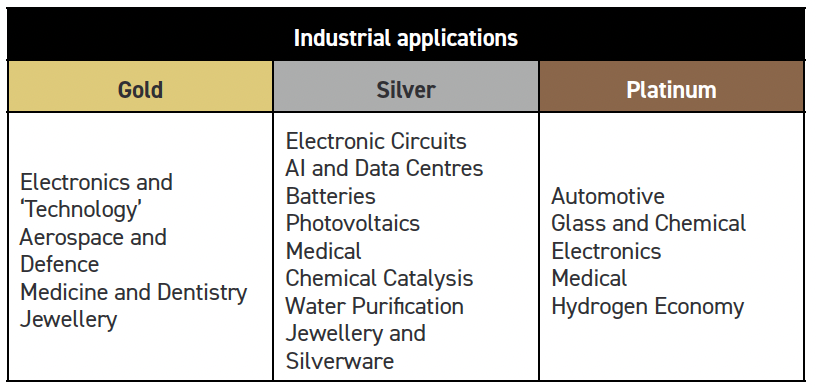
A number of the industrial applications noted above are important drivers of near-term demand for silver and platinum. This includes silver used for electronic circuits, AI and data centres, batteries, and photovoltaics, in addition to platinum used for automotive, glass and chemical, and electronics.
The price rise
The key catalysts for the sharp rise in prices were:
- Industrial demand for silver and platinum reached critical levels, driven by solar power, electric vehicles, batteries and the emerging demand from AI data centres.
- Traders accumulated and warehoused large volumes of silver in anticipation of the impact of US tariffs.
- Central banks, which have historically used the US dollar to facilitate trade, anchor exchange rates and support economic stability, have been reducing their US dollar holdings and buying gold. Concerns about rising US debt, US monetary policy and the use of geopolitical sanctions have encouraged institutional buying, placing a significant floor under gold prices.
- Ongoing geopolitical unrest in the Middle East, Ukraine, and Latin America encouraged a flight to safety.
- Leveraged trading by hedge funds, algorithmic traders and other leveraged investors, combined with 'FOMO' (fear of missing out)-driven retail buying, continued to push silver and platinum prices higher.
And the fall
If these factors drove the sharp rise in prices, what caused the subsequent falls?
For gold, the decline appears counterintuitive: despite heightened geopolitical uncertainty, the metal – typically viewed as a safe-haven asset – has fallen for several reasons:
- A possible temporary easing in central bank demand, even though the underlying reasons for the earlier rise remain in place.
- Profit-taking and the need to meet margin calls.
- A stronger US dollar, which made gold more expensive for international buyers.
- A shift into alternative asset classes, such as bonds, cash and even oil.
For silver, the decline was also driven by profit-taking after exchange operators raised margins, a stronger US dollar that made silver more expensive for international buyers, and the liquidation of speculative positions triggered by margin calls and algorithmic corrections.
For platinum, the decline was mainly due to increased supplies of raw and recycled materials, weaker demand as combustion-engine use fell, and profit-taking as investment houses exited their positions.
The near term future
Predicting demand and prices for precious metals will require a crystal ball, with commodity and precious-metal experts offering forecasts in 2027 that range from further small corrections to significant gains, particularly for silver.
Before offering guidance, it is useful to first consider the environmental factors that could affect demand for gold, silver and platinum.
- Geopolitical – although uncertainty and tension may have eased, unresolved issues and continuing conflicts, such as the war in Ukraine, are likely to maintain an elevated level of global uncertainty.
- US economy and policy settings – although the outcome of the US midterm elections may influence government direction, rising debt, policy uncertainty, growing frustration with the increasing cost of living and recession risk could all characterise the US economy in 2027.
- World economy, inflation and cost of living – the IMF expects inflation to ease and GDP growth to reach around 3% to 3.4%, supported by lower energy pressures and investment in AI. However, it also cautions that geopolitical risks, US policy uncertainty and persistent cost-of-living pressures could weigh on growth.
- Climate – climate change remains a continuing concern, and events such as wildfires, major floods or droughts could affect the global economy and hasten the transition to and demand for renewable energy.
- Industrial demand – demand for precious metals in the industrial applications highlighted above, particularly silver, is likely to accelerate in 2027, although rising supply may partly temper this growth.
- Sovereignty – this heading reflects the continued determination of some countries, including China, the Czech Republic, Central Asian nations, Poland and parts of South America, to reduce their reliance on the US dollar and bond market by continuing to invest in physical gold.
- Equity markets – as with precious-metal forecasts, expectations for equity markets in 2027 vary. The consensus points to steady growth, although some analysts warn of correction risks linked to persistent inflation, slowing profit growth and overcapitalisation in the race to dominate AI.
Conclusion
Underlying demand for precious metals – from central banks for gold, industrial applications for silver, and supply constraints affecting platinum – should at least provide a floor for prices. Easing inflation, the potential for slower economic growth to prompt interest-rate cuts, ongoing geopolitical tensions and concern about equity-market corrections could together create 'safe haven' conditions for precious metals to regain some lost ground in 2027.
J P Morgan has forecast gold trading between $5,400 and $6,300, and silver reaching $85. Goldman Sachs has projected an upper price of $5,500 for gold and $85 to $100 for silver.
Looking ahead to 2030, many trading houses and financial institutions expect precious-metal prices to strengthen further, driven mainly by concerns about sovereign debt and equity-market uncertainty.
Get the Coin & Mint News™ Weekly delivered free to your inbox.